
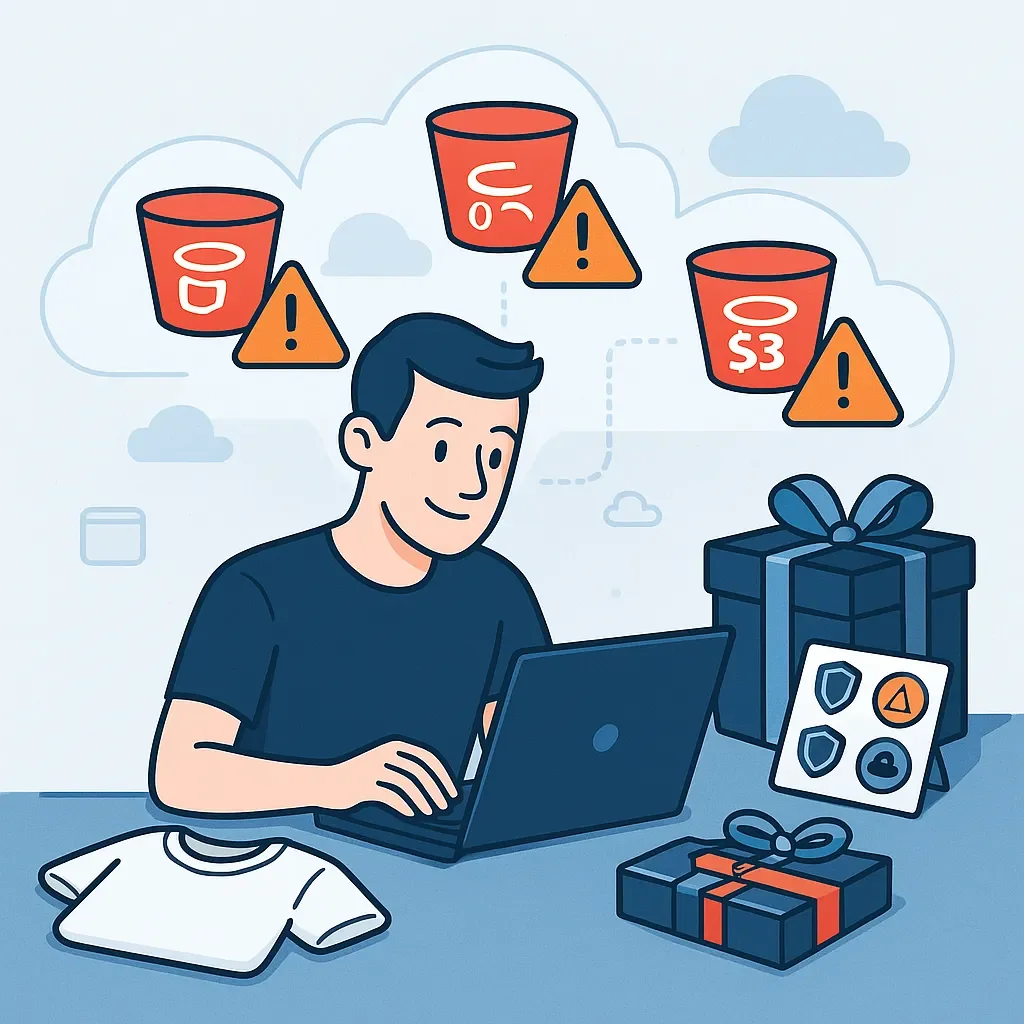
5 S3 Bucket Takeovers That Earned Me Swag from Sony
How subdomain enumeration, manual review and a single S3 error page led to five S3 bucket takeovers on Sony’s scope — and a swag reward through HackerOne.
Ciphervigil · 27 Apr 2025 · 3 min read · 10 views
During one of my recent security assessments, I discovered five misconfigured Amazon S3 buckets associated with Sony. These vulnerabilities, if left unaddressed, could have led to sensitive data exposure, website defacement, or other major security risks.
This write-up highlights the finding, the approach I took, and the outcome.
🛠️ The Approach
In the Sony program, the scope was extended to include all subdomains of sony.com (*.sony.com). The first step here is to find all subdomains. There are many tools available for this purpose — I used subfinder and found approximately 10,429 subdomains.
subfinder -dL domainList.txt | httpx | tee live.txt
After enumerating all possible subdomains related to Sony's assets, I used Subzy to scan for potential subdomain takeovers. However, the scan didn't yield any vulnerable subdomains at this stage.
subzy -r --targets live.txt
While Subzy initially flagged several subdomains as potentially vulnerable, a manual verification revealed that they were all false positives. None of the flagged domains were actually pointing to unclaimed or misconfigured services.
Our next step is to examine each of these sites in detail. I use a Chrome extension that can open all the domains I've found at once, and I start checking all the subdomains. I landed on a subdomain of interest: abc.xyz.com. This page displayed a raw error response, indicating that it was tied to an AWS S3 bucket:
<Error>
  <Code>NotFound</Code>
  <Message>The resource you requested does not exist</Message>
  <RequestId>AKFKS7AN2CBM2667</RequestId>
  <HostId>5zzD9y7nGDL3S54rT0eLqxoS0orLWiy92ey5UsViQP5/C9BxG8vNQAYwGmZZ0Q+9xJIwvS+M2EY=</HostId>
</Error>
This response strongly suggested that the site was attempting to serve content from an S3 bucket that no longer exists or is not properly configured — a common indicator of a potential S3 bucket takeover opportunity.
🪣 Taking Over the Bucket
After identifying that abc.xyz.com was pointing to an AWS S3 bucket with an error indicating missing resources, I checked whether this misconfiguration could actually be exploited.
To do that, I created a new S3 bucket with the same name as the original one — abc.xyz.com — on my own AWS account. Because S3 bucket names are globally unique, being able to create it confirmed that the original bucket had been left unclaimed.
After creating the bucket, I uploaded a test file and noticed that the bucket URL used the default AWS S3 endpoint format:
abc.xyz.com.s3.ap-south-1.amazonaws.com
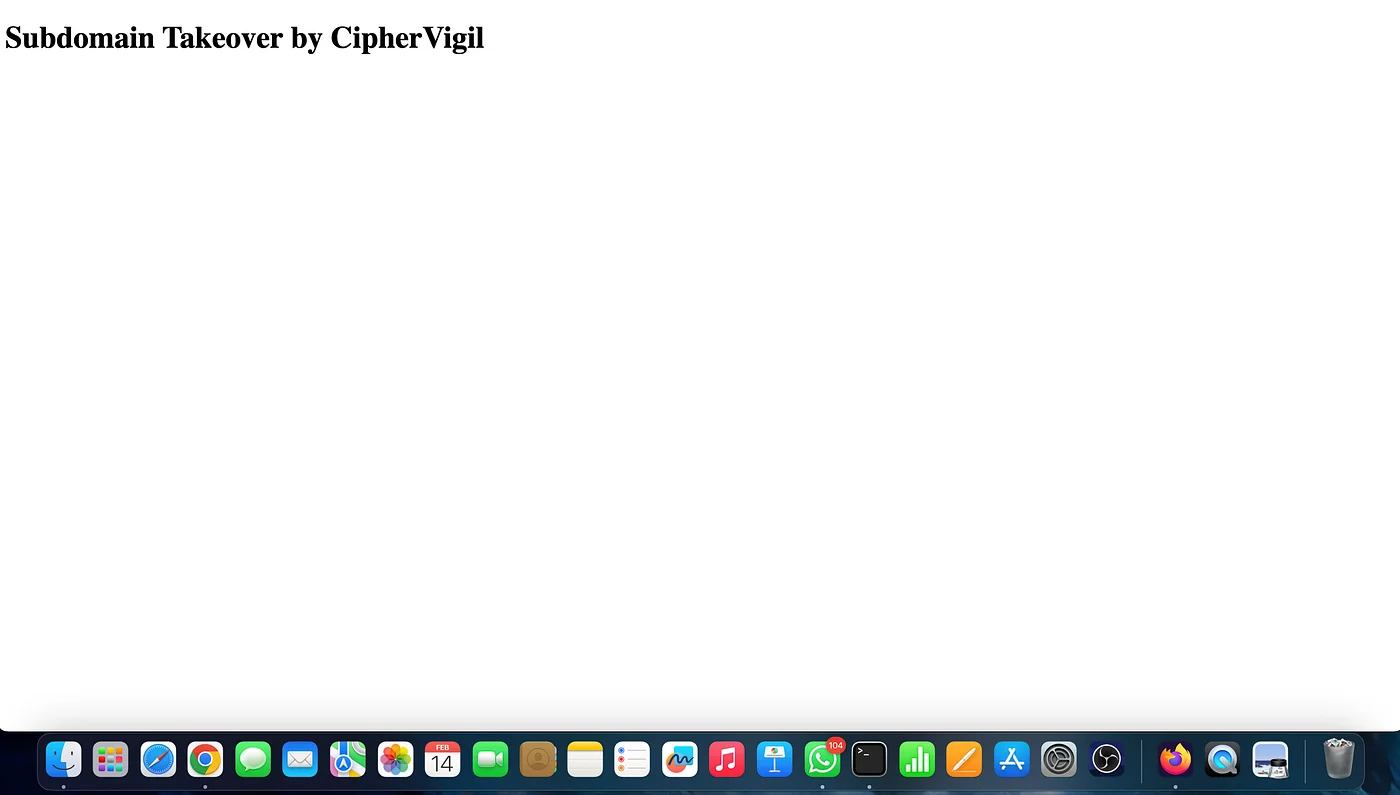
This was the URL of my newly created bucket, and it now hosted the content I uploaded — demonstrating that the original subdomain was now serving content from my bucket.
📩 Responsible Disclosure
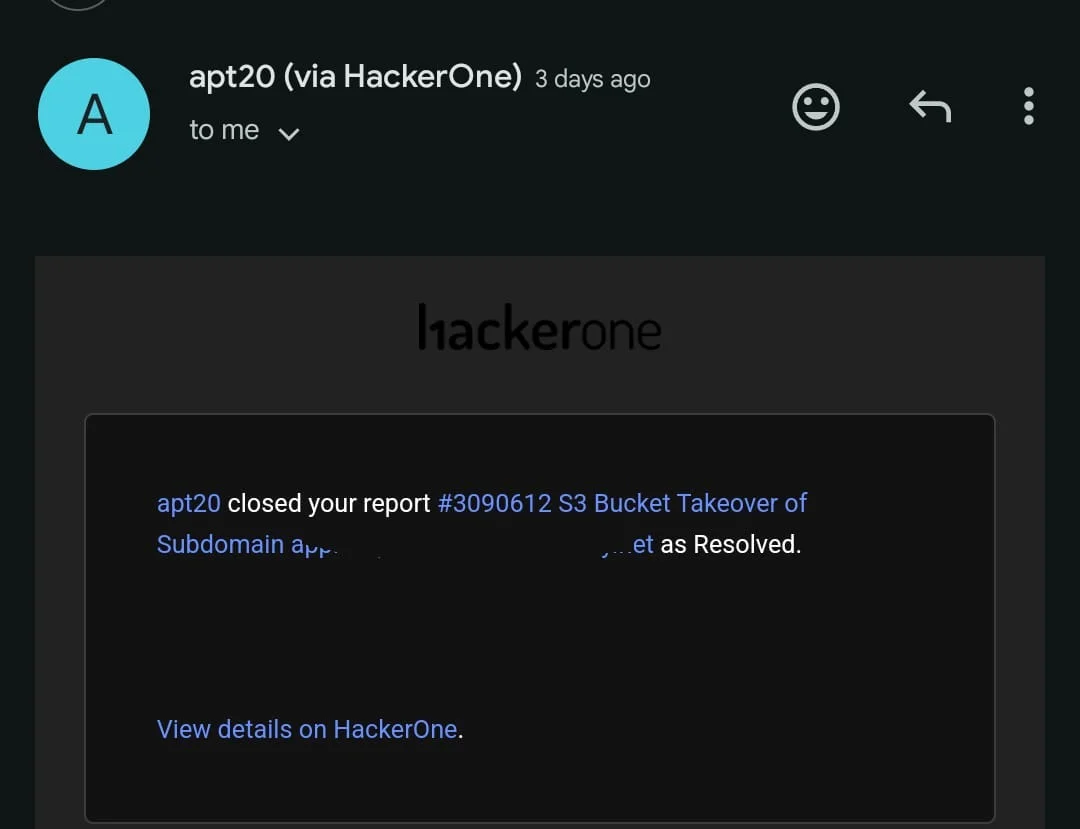
Once I had confirmed the S3 bucket takeover, the next step was to responsibly disclose the issue. I submitted a detailed report through HackerOne, outlining the vulnerability, the steps to reproduce it, and the potential security risks it posed.
🎁 The Outcome
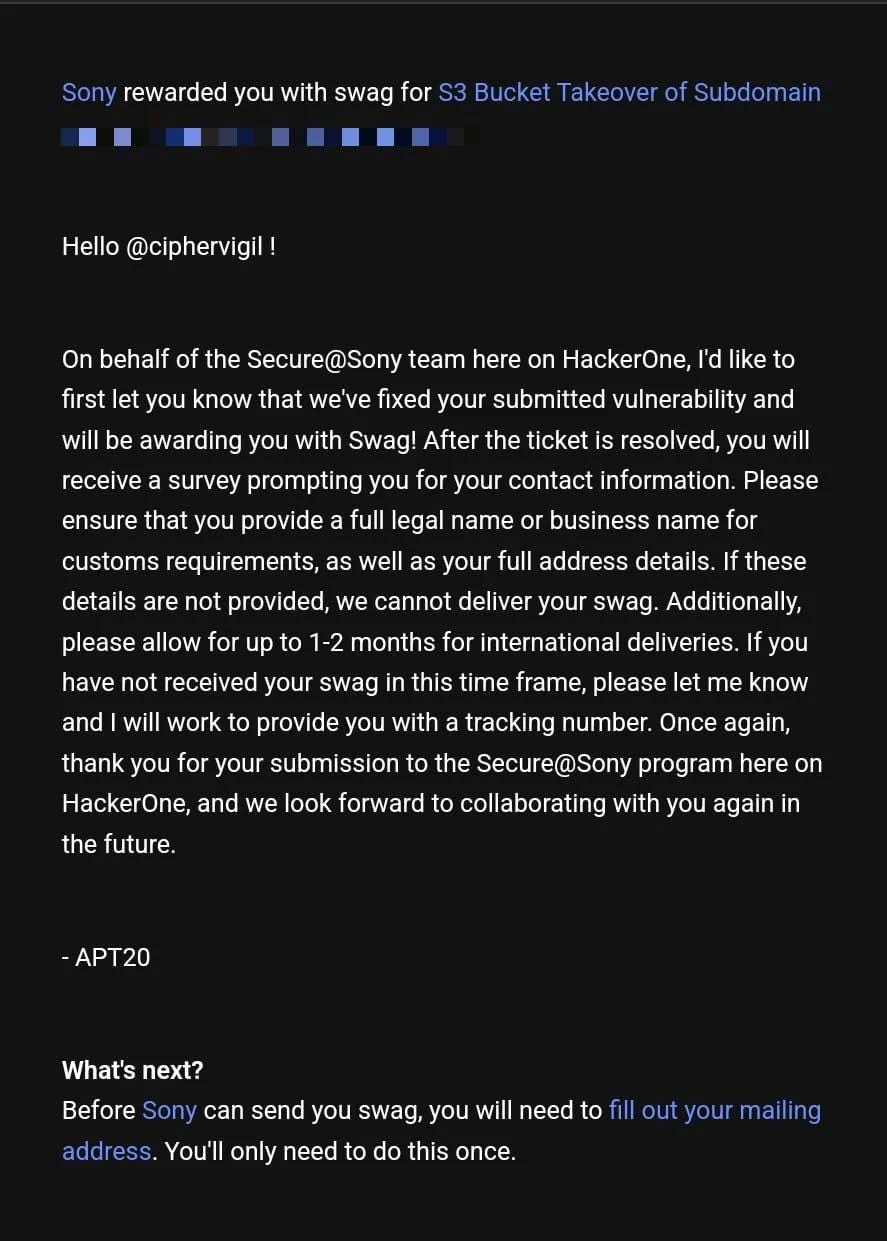
About a day later, my report was triaged and Sony acknowledged the vulnerability. The fix was rolled out, and I was rewarded with Sony swag for my efforts. It was incredibly satisfying to see my findings contribute to improving the security of their systems.
💡 Key Takeaways
- Don't trust automated takeover scanners blindly — tools like Subzy produce false positives and miss real issues. Manual review found what the scan didn't.
- Look at every live host. Opening all subdomains and reading their responses is how this bug was found.
- A
NoSuchBucket/NotFoundS3 error on a company subdomain is worth investigating — but always verify within the program's scope and rules. - Report clearly: steps to reproduce, proof of concept and impact make triage fast.
This is my first write-up on a security vulnerability, and I'm excited to share my experience. It's been a great learning journey, and I'm looking forward to more discoveries and challenges ahead!
Want to learn the recon workflow behind findings like this? Check out The Bug Hunter's Recon Methodology.
Originally published on Medium. Follow me on X, LinkedIn and YouTube.
$ ./level_up.sh
Want to learn this hands-on?
Join our Ethical Hacking & Bug Bounty courses — in Hindi, with lifetime access.
Explore Courses →